ByJohn A
Distributed Dual-Cell Power Delivery Networks vs. Monolithic High-Density Battery Architecture in iphone duo and iphone 18 pro
As mobile system-on-chip (SoC) microarchitectures transition to 2nm nodes, operational power density demands precise electrical and thermal management. While computational blocks have become vastly more power-efficient per transistor switching cycle, modern peak execution states—driven by real-time spatial rendering and multi-modal machine learning pipelines—require continuous high-amperage current delivery. Consequently, chemical energy storage and power management integrated circuit (PMIC) topologies form a primary hardware bottleneck.
91Mobiles
Comparing the distributed dual-cell battery system of iphone duo with the monolithic single-cell architecture of iphone 18 pro highlights two distinct electrical engineering philosophies. This structural analysis evaluates the trade-offs in electrochemical spatial efficiency, interconnect impedance matching, dynamic voltage drop, cell-balancing logic, and overall system energy degradation.
Electrochemical Configuration and Volumetric Packing Efficiency
Energy storage in a mobile chassis requires balancing overall physical volume against usable electrical capacity. Packaging constraints dictate how electrochemical cells are structured and integrated into internal power delivery networks.
| Power Parameter | Distributed Dual-Cell Architecture | Monolithic Unibody Architecture |
| Physical Housing Layout | Asymmetric split-pack distribution across mechanical hinge | Single contiguous high-density pouch cell |
| Volumetric Storage Efficiency | Lower (~70%–75% net spatial utilization) | Higher (~82%–88% net spatial utilization) |
| Packaging Overhead | Dual aluminum pouches, dual safety circuits (PCM) | Single protective pouch and unified protection module |
| Equivalent Series Resistance (ESR) | Higher loop impedance due to dynamic flex interconnects | Minimal native internal resistance across single busbar |
| Cell Balancing Requirement | Active dual-channel PMIC balancing algorithm required | Passive single-loop equilibrium control |
| Maximum Localized C-Rate | Constrained by thin interconnect heating thresholds | High instantaneous current discharge ceiling |
Monolithic Single-Cell Integration
The rigid unibody chassis of iphone 18 pro houses a monolithic high-density lithium-ion pouch cell. Eliminating articulated hinges or physical chassis divisions allows a single continuous battery casing to fill available internal volume.
Single-cell engineering minimizes volumetric overhead by consolidating structural protective seals, thermal insulation layers, and localized protection circuit modules (PCMs) into a single hardware assembly. This high spatial efficiency maximizes energy density per cubic centimeter. Furthermore, connecting short, solid copper tabs directly to the main system motherboard ensures extremely low Equivalent Series Resistance (ESR), optimizing instantaneous current delivery directly to high-drain power rails.
Distributed Dual-Cell Integration
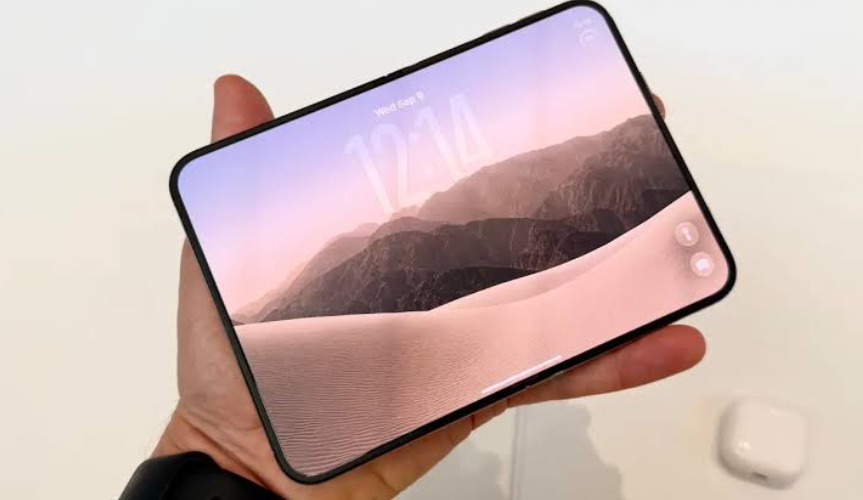
The foldable architecture of iphone duo divides energy storage into two physically isolated battery packs situated on opposite sides of a mechanical hinge mechanism. One housing contains the primary system-on-chip and camera arrays alongside a smaller secondary cell, while the opposite housing accommodates a larger primary cell to offset component displacement.
This split layout creates mandatory packaging overhead. Each battery pouch requires its own aluminum-laminated protective barrier, internal current collectors, positive/negative terminals, and dedicated PCM sub-assemblies. This duplicated housing infrastructure reduces net volumetric efficiency compared to a monolithic structure, requiring advanced high-density silicon-anode cell chemistries to reclaim lost chemical storage volume.
Interconnect Impedance, IR-Drop, and High-Current Topology
Routing electrical power across a dynamic mechanical joint introduces impedance challenges that affect voltage regulation and transmission efficiency under high loads.
Total power loss across an internal conductor is defined by Joule’s Law:
Ploss=I2⋅Rinterconnect
In iphone 18 pro, short, thick copper busbars connect the monolithic battery to the main power management integrated circuit. The interconnect resistance (Rinterconnect) across this static interface is minimal, keeping thermal energy losses low even during peak operational bursts, such as sustained gaming or high-wattage fast charging.
In iphone duo, drawing power from the secondary cell located in the opposite housing requires routing electrical current across the articulated hinge. This path relies on multi-layer Flexible Printed Circuits (FPC) designed to withstand thousands of dynamic flex cycles. Thin copper traces integrated into dynamic polyimide flex cables exhibit higher electrical resistance than solid metal tabs.
Drawing high current from the secondary cell across this moving junction creates a dynamic voltage drop (IR-drop):
Vdelivered=Vcell−(Idraw⋅Rhinge_flex)
Under peak computational workloads, this voltage drop can cause rail instability if not actively managed by dynamic multi-channel step-up converters and local decoupling capacitors.
Charge Management, Thermal Asymmetry, and Cycle Aging
Charging and discharging two independent battery cells operating in different thermal environments presents distinct management challenges.
Parallel Cell Current Distribution: Itotal=Icell_primary+Icell_secondary
Vsystem=Vcell_primary−(Iprimary⋅Rprimary)=Vcell_secondary−(Isecondary⋅Rsecondary)
Because the primary cell in iphone duo sits adjacent to the main processing SoC and display driver integrated circuits, it experiences higher average ambient operating temperatures than the secondary cell located in the cooler auxiliary housing. This thermal asymmetry creates divergent aging characteristics over time:
- Impedance Divergence: Higher operating temperatures accelerate solid electrolyte interphase (SEI) layer growth in the primary cell, increasing its internal resistance faster than that of the secondary cell over hundreds of charge-discharge cycles.
- Dynamic Energy Rebalancing: To prevent the cooler, lower-resistance cell from forcing reverse-current flow into the hotter, higher-impedance cell, iphone duo utilizes intelligent power management algorithms. These control loops adjust voltage buck-boost converters in real time, balancing charge draw to preserve long-term battery cell health.
- Multi-Channel Health Monitoring: Operating system power management must monitor state-of-charge (SoC), temperature, and cycle counts for both physical cells independently, synthesizing them into a unified system power metric for the user interface while managing separate voltage curves underneath.
In contrast, iphone 18 pro operates within a unified thermal management envelope. Heat generated by the central processor spreads evenly across the monolithic battery pouch via internal graphite spreaders and a continuous vapor chamber assembly. This uniform temperature distribution keeps degradation rates equal across the entire chemical sheet plane, simplifying charge-control logic and extending overall lifespan.
Operational Power Delivery Efficiency and System Dynamics
The physical layout of internal energy reserves dictates system-level power delivery behavior across idle, steady-state, and high-burst operational profiles.
Peak Sustained Burst Capacity
During demanding computational tasks, the 2nm system processor draws high continuous current. The monolithic cell layout in iphone 18 pro maintains a low total internal impedance path, delivering consistent voltage stability without excessive heat generation along the power delivery network. This low internal resistance supports high peak sustained clock frequencies under heavy processing loads.
Dynamic Partitioned Idle Powering
Conversely, iphone duo leverages its split battery architecture during dynamic power scaling states. When operating exclusively on the compact cover display, localized power gating can isolate or downscale auxiliary power convertors linked to the inner display infrastructure, reducing quiescent current draw. However, when the internal display is fully unfolded, the power distribution network drives both battery channels simultaneously, dynamically balancing current draw across the hinge to power expanded display driver ICs and system logic without exceeding localized thermal boundaries.
See also: Learn Quran Recitation with Tajweed Step-by-Step in the UK & USA
Architectural Synthesis
Evaluating power distribution design across both devices reveals two refined engineering solutions tailored to distinct form factors:
- Monolithic Efficiency: The single-cell architecture of iphone 18 pro prioritizes volumetric energy density, ultra-low internal electrical resistance, simplified single-loop charging, and uniform thermal degradation.
- Distributed Flexibility: The dual-cell layout of iphone duo relies on advanced multi-channel PMIC management, active energy rebalancing algorithms, and multi-layer flex-bridging interfaces to provide reliable energy distribution across an articulated, dual-housing enclosure.
adobo Magazine